How to Fix Schwintek Slide 6-Flash Error Code: Motor Short Troubleshooting Guide
Read full question
Quick Answer
Schwintek 6-flash code means motor short to ground. Test by disconnecting motor and checking resistance - should be 1-10 ohms between leads and infinite to ground. Common causes are damaged wiring, water intrusion in motor, or failed controller.
Short Answer
Your 2020 34PA's alternating Motor 1 and Motor 2 six-flash codes likely indicate intermittent wiring issues rather than actual motor shorts, especially since both motors continue to function after the reset. Given your extensive electrical troubleshooting work and the fact that you've found multiple loose connections throughout the system, you're probably dealing with remaining poor connections or damaged wire insulation in the motor harnesses. The good news is you probably don't need to replace both motors - focus on inspecting and replacing the motor wiring harnesses first, as Schwintek controllers are very sensitive to voltage drops and resistance changes that can trigger false short codes.
Understanding the Problem
The Schwintek controller's six-flash error code for "internal motor short" is actually quite sensitive and can be triggered by several conditions beyond actual motor failure. In your case, the alternating between Motor 1 and Motor 2 codes strongly suggests wiring harness issues rather than motor problems. When you have intermittent high resistance connections, corroded terminals, or damaged wire insulation, the controller sees voltage irregularities that it interprets as motor shorts.
Your symptom pattern - where the first button push does nothing but the second push works perfectly - is classic behavior when the controller detects a fault, goes into protection mode, then resets on the first button push and operates normally on the second. This is actually the system working as designed to protect the motors from potential damage.
Since you've already done extensive electrical work and found multiple loose connections, you're likely dealing with the motor harnesses themselves. These harnesses run through tight spaces, get flexed repeatedly during slide operation, and are exposed to road vibration and weather. The wire insulation can crack internally or terminals can develop intermittent connections that only show up under load conditions.
The fact that both motors are throwing the same error code alternately is actually a clue - it suggests a common issue affecting both circuits, possibly at the controller connection point or in the main power feed to the controller. This is much more likely than both motors developing internal shorts simultaneously.
What You'll Need
For proper diagnosis, you'll need a digital multimeter capable of measuring resistance and continuity, along with a set of basic electrical tools. For accurate diagnosis of motor wiring issues, use a multimeter that provides reliable low-resistance readings - motor winding resistance should be checked against manufacturer specifications for your specific model (consult Lippert documentation for acceptable ranges). You'll also need electrical contact cleaner, dielectric grease, and possibly replacement motor harnesses if damage is found.
Schwintek motor harnesses for your 2020 unit typically cost between $150-250 (rough ballpark — actual cost varies by region, brand, and model year and changes over time, so get current quotes) each from Lippert (verify the correct part for your model with dealer). If you need to access the motors, have a drill with bits ready as you may need to remove access panels. A wire brush or sandpaper will help clean corroded terminals.
Consider getting a Schwintek diagnostic tool or having a dealer run diagnostics, as these can provide more detailed fault information than just the LED flash codes. However, given your electrical skills and the work you've already done, manual testing with a multimeter should be sufficient to identify the problem areas.
How to Fix It
SAFETY WARNING: Before beginning any electrical work, disconnect all power to the slide system by turning off the appropriate breaker/fuse at the main panel and physically disconnecting the power leads at the controller. Use proper lockout/tagout procedures to prevent accidental re-energization. Be aware that capacitors in the system may retain stored energy even after power disconnection - allow time for discharge before handling components.
Start by carefully inspecting all connections at the Schwintek controller. Look for any signs of corrosion, loose terminals, or damaged wire insulation. Clean all connections with electrical contact cleaner and apply dielectric grease before reconnecting. Pay special attention to the main power connections and ground points.
Next, test the motor harnesses by disconnecting them at both the controller and motor ends. WARNING: Ensure the slide is fully supported and cannot move unexpectedly during testing, as electrical troubleshooting may cause unintended slide operation. With the motors fully disconnected from the controller, use your multimeter to check the resistance between each wire pair in the harness. You should see consistent readings with no infinite resistance (open circuits) or near-zero resistance (shorts). Also check for continuity between each conductor and ground - there should be no continuity, indicating no shorts to ground.
If the harnesses test bad, replacement is usually the most reliable fix rather than trying to repair damaged sections. When installing new harnesses, route them carefully to avoid pinch points and secure them properly to prevent chafing. Make sure all connections are clean and tight, using dielectric grease on all terminals.
Before reassembling everything, test the motor windings directly at the motors. Each motor should show consistent resistance readings between windings (check manufacturer specifications for acceptable range), and infinite resistance between any winding and the motor case. If the motors test good but you're still getting codes with new harnesses, the controller itself may need replacement, though this is less likely given your symptoms.
Leave It to the Experts
While your electrical troubleshooting skills are clearly solid based on the work you've described, Schwintek systems can be tricky to diagnose properly. If replacing the motor harnesses doesn't resolve the issue, or if you're uncomfortable working with the 24V DC motors, consider having a certified Lippert service center perform the diagnosis. They have specialized diagnostic equipment that can pinpoint exactly which component is causing the fault codes.
Professional diagnosis typically costs $100-150 but can save you from replacing the wrong components. Given that a complete controller replacement runs $400-600 and motors are $300-500 each, proper diagnosis is worth the investment. Many RV service centers are familiar with these exact symptoms on Schwintek slides and may be able to resolve it quickly.
If you do decide to tackle it yourself, document everything with photos before disconnecting anything, and test each component systematically. The alternating fault codes suggest you're close to finding the root cause - it's likely just one or two bad connections or damaged harness sections causing both motors to throw codes intermittently.
Tools & Supplies You'll Need
 AstroAI Digital Multimeter and Analyzer TRMS 6000 Counts Volt Meter Ohmmeter
Reads volts, continuity, and resistance — the #1 tool for tracing 12V faults. View on Amazon →
AstroAI Digital Multimeter and Analyzer TRMS 6000 Counts Volt Meter Ohmmeter
Reads volts, continuity, and resistance — the #1 tool for tracing 12V faults. View on Amazon →
 IRWIN Vise-Grip Wire Stripper, 2 Inch Jaw, Cuts 10-24 AWG, ProTouch for
Strips and crimps in one tool — clean connections every time. View on Amazon →
IRWIN Vise-Grip Wire Stripper, 2 Inch Jaw, Cuts 10-24 AWG, ProTouch for
Strips and crimps in one tool — clean connections every time. View on Amazon →
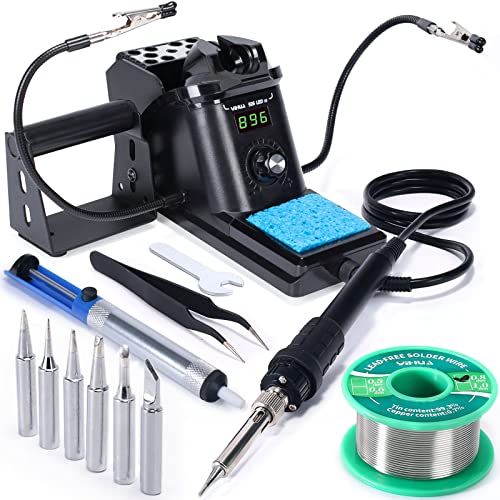 YIHUA 926 III 60W Digital Display Soldering Iron Station Kit w 2 Helping
Adjustable iron + solder for permanent wiring and board repairs. View on Amazon →
YIHUA 926 III 60W Digital Display Soldering Iron Station Kit w 2 Helping
Adjustable iron + solder for permanent wiring and board repairs. View on Amazon →
 CRAFTSMAN 230 Pcs Mechanics Tool Set, Socket Wrench Set, Car Tool Kit with
A broad SAE/metric socket-and-ratchet set covers most RV fasteners. View on Amazon →
CRAFTSMAN 230 Pcs Mechanics Tool Set, Socket Wrench Set, Car Tool Kit with
A broad SAE/metric socket-and-ratchet set covers most RV fasteners. View on Amazon →
Still need help? Ask an RV Mechanic
Get a personalized answer from a verified RV mechanic. Describe your specific issue and get step-by-step help for your rig.
Related Repair Guides
- Power Gear Leveler Won't Retract: Complete Repair Guide
- How to Fix RV Slideout Rubbing Against Exterior Wall - Complete Repair Guide
- RV Slide Out Won't Retract: Motor Runs But Won't Move - Fix
- RV Electric Leveling Jacks Won't Extend - Fix Clicking Issue
- RV Slide Out Water Leak Repair: Complete Guide to Finding & Fixing Leaks in Your RV
- How to Replace Atwood Levelegs Control System with GAMA Electronics RF340-4PR Controller
- RV Hydraulic Leveling Jack Leaks: Normal Seepage vs Serious Problems Explained
- RV Slide Out Moving Slowly? Complete Lubrication & Repair Guide
- RV Slide-Out Systems: Complete Maintenance & Repair Guide
- How to Lift RV Slideout for Floor Repair - Safe Methods
Need More Help?
Try our free RV calculators and tools to help diagnose and plan your repairs.
Browse RV ToolsWeight calculator, electrical planner, propane estimator & more
