DIY RV Basement Door Paint Repair: Complete Guide & Cost Analysis
Read full question
Has anyone successfully tackled RV exterior panel paint repair as a DIY project? I need reassurance that this is actually doable without professional training, and guidance on the complete process from start to finish.
Quick Answer
Professional RV basement door paint repairs can cost $5,000-6,500, but DIY repairs are possible for under $500 with proper preparation and equipment. This comprehensive guide covers paint matching, surface preparation, spray gun selection, and application techniques for achieving professional-quality results on sun-damaged RV exterior panels.
Short Answer
You're absolutely right to be frustrated with those quotes - $5-6 (rough ballpark — actual cost varies by region, brand, and model year and changes over time, so get current quotes).5K for a 2' x 20' area on basement doors is excessive. Your DIY approach is completely feasible and should cost under $500 as you estimated. With proper prep work, primer, and a gravity feed gun, you can achieve professional-looking results on those driver's side basement doors and rear wheel area. The key is taking your time with surface preparation and applying thin, even coats.
Understanding the Problem
UV damage on RV basement doors is extremely common, especially on the driver's side which gets more direct sun exposure during travel and parking. The paint failure you're seeing likely includes chalking, fading, peeling, or complete adhesion loss. This type of damage typically starts with the clear coat breaking down, then progresses to the base color layer.
The high shop quotes reflect several factors: RV paint matching can be tricky since manufacturers use various paint codes, the large surface area requires significant masking and prep time, and shops often price RV work higher due to the specialized nature. However, basement doors are actually ideal for DIY painting since they're flat surfaces without complex curves, and any minor imperfections won't be as noticeable as they would be on the main body panels.
Your plan to tackle this yourself makes perfect sense. Basement doors don't require the same level of finish perfection as visible body panels, and with modern automotive paints and proper technique, you can achieve results that are 90% as good as a professional shop for less than 10% of the cost.
What You'll Need
For your gravity feed setup, you'll want a gun with a 1.4mm tip for primer and basecoat and 1.2-1.3mm for clear coat. Plan on about 4-8 CFM air consumption, so your compressor should handle this fine. A water separator and regulator are essential for clean, consistent pressure.
Material-wise, budget around $150-200 for a quart each of primer, basecoat, and clear coat - this should cover your 40 square foot area, though you may want extra material to account for overspray and multiple coats. Add $100-150 for supplies: 400, 800, and 1500 grit sandpaper, tack cloths, masking tape and paper, cleaning solvents, and mixing cups. Don't forget a quality respirator and protective clothing.
For paint matching, take a sample from an inconspicuous area to an automotive paint supplier. Many can scan and mix custom colors, or check if your RV manufacturer published paint codes. Popular RV paint brands include PPG, Sherwin-Williams Automotive, and Axalta - all offer single-stage or base coat/clear coat systems suitable for fiberglass.
Consider renting or buying a small spray booth setup or at minimum, plastic sheeting to create a dust-free environment. Spring for a good compressor filter system since any moisture or oil contamination will ruin your finish.
How to Fix It
Start with thorough cleaning using degreasing agents, then sand the failed paint areas down to stable substrate - this might mean going to primer or even fiberglass in badly damaged spots. Use 400-grit for initial sanding, then progress through 800-grit for smoothing. Any deep scratches or gouges should be filled with automotive body filler and sanded smooth.
Mask extensively - basement door painting requires protecting slide mechanisms, hinges, locks, and adjacent surfaces. Use high-quality automotive masking tape and paper, creating clean, straight lines. Remove door hardware if possible, or mask very carefully around latches and hinges.
Apply primer in thin, even coats - two to three coats typically provide adequate coverage and adhesion. Allow proper flash time between coats (usually 15-30 minutes depending on temperature and humidity). Sand lightly with 800-grit between primer coats if needed for smoothness.
For base coat application, maintain consistent gun distance (6-8 inches) and overlap each pass by 50%. Apply in thin coats - it's better to do four light coats than two heavy ones. Follow with clear coat using the same technique, typically 2-3 coats for durability. Wet sand with 1500-grit and polish if you want show-car results, but this isn't necessary for basement doors.
Leave It to the Experts
While your DIY approach is sound for basement doors, there are situations where professional work is worth the investment. If the damage extended to highly visible areas like the main body panels, cab, or areas with complex curves and graphics, the professional finish quality becomes more important.
Consider professional work if you discover structural issues during prep - sometimes UV damage indicates deeper problems with the fiberglass substrate that require specialized repair techniques. Also, if your RV has custom graphics or multi-stage paint that requires precise color matching across large visible areas, professional color matching and blending expertise becomes valuable.
For your current situation with basement doors, the professional quotes seem unreasonable. These doors take significant abuse from road debris and weather anyway, so a quality DIY job will serve you well. Save the professional money for more critical cosmetic areas if needed in the future, and use this project to build your painting skills and confidence.
Tools & Supplies You'll Need
 Amartisan 10-Piece Magnetic Screwdrivers Set, 5 Phillips and 5 Slotted Tips
Phillips, flat, and Torx tips for panels, trim, and appliances. View on Amazon →
Amartisan 10-Piece Magnetic Screwdrivers Set, 5 Phillips and 5 Slotted Tips
Phillips, flat, and Torx tips for panels, trim, and appliances. View on Amazon →
 Dicor 610SASLW-1 Self-Leveling Ultra Sealant System - 10.1 Oz, White, High
Seals roof penetrations on flat/low-slope RV roofs. View on Amazon →
Dicor 610SASLW-1 Self-Leveling Ultra Sealant System - 10.1 Oz, White, High
Seals roof penetrations on flat/low-slope RV roofs. View on Amazon →
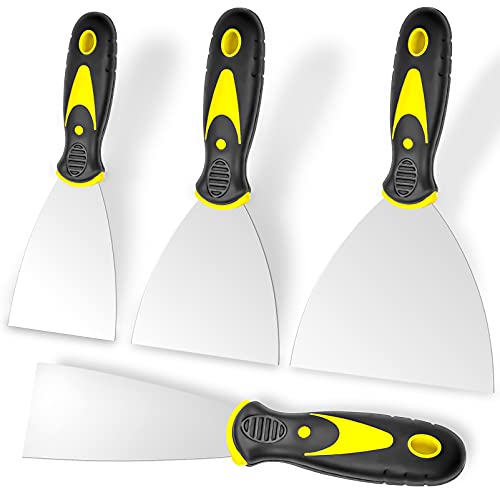 Putty Knife, 4Pcs Spackle Knife Set (2, 3, 4, 5 in), Stainless Steel Paint
Lifts old butyl tape and lap sealant without gouging. View on Amazon →
Putty Knife, 4Pcs Spackle Knife Set (2, 3, 4, 5 in), Stainless Steel Paint
Lifts old butyl tape and lap sealant without gouging. View on Amazon →
Still need help? Ask an RV Mechanic
Get a personalized answer from a verified RV mechanic. Describe your specific issue and get step-by-step help for your rig.
Related Repair Guides
- How to Repair RV Roof Soft Spots: Fix Water-Damaged Wood Step-by-Step Guide
- RV Rubber Roof Bubbling? How to Repair EPDM Separation
- RV Sidewall Blistering & Delamination Repair Guide
- Fix Cracked Dometic RV AC Covers & Roof Vents
- How to Replace RV Slide Topper Fabric: Complete DIY Guide
- Kwikee RV Steps Not Working? Complete Troubleshooting Guide
- Carefree RV Awning Spring and Arm Replacement Guide - Model Compatibility Tips
- RV Roof Leak Around Air Conditioner: Complete Repair Guide
- How to Fix a Seized RV Side Mirror - Complete Repair Guide
- RV Window Seal Leaking: Complete Repair Guide & Solutions
Need More Help?
Try our free RV calculators and tools to help diagnose and plan your repairs.
Browse RV ToolsWeight calculator, electrical planner, propane estimator & more
